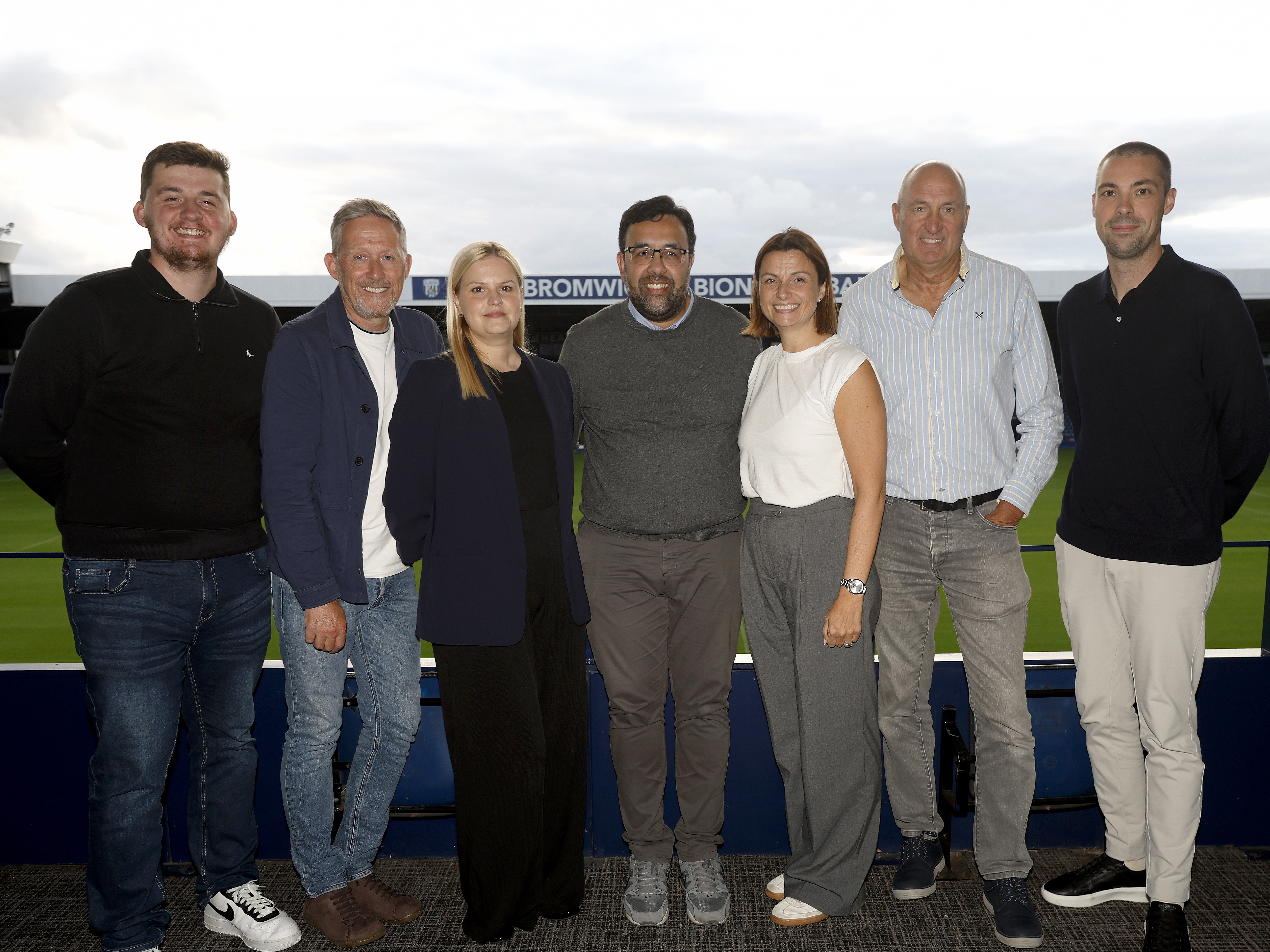
Albion’s Fan Advisory Board (FAB) met with club officials for the third time in May and a summary of the meeting can be found below.
Thursday, May 14, 2026 - 6pm at The Hawthorns
The following is a general summary of the meeting and contains no direct quotations.
Supporters can learn more about the role of the FAB, here, while member profiles can be found, here – and the FAB constitution, here.
Club attendees: Ian Skidmore (Co-Chair, Director of Communications & Fan Engagement), Mark Miles (Executive Director), Ashish Patel (Chief Marketing Officer), Chris Harris (Director of Operations & SHE (Safety, Health & Environment)), Sam Jeffrey (Chief Business Officer), Rob Lake (Director, The Albion Foundation), Tom Chadwick (Director of Events, Experience & Technology).
FAB attendees: Richard Jefferson (Vice-chair), Christian Black, Hannah Butler, Shin Aujla, Dean Walton, Ben Deeley.
Apologies: Dan Head, Sarah Kerton, Mark Whitehouse, Clare Sidaway.
OPENINGS & INTRODUCTIONS
Ian Skidmore (IS) welcomed all attendees and reintroduced Mark Miles (MM), who returned to the Club as Executive Director in February.
PROFITABILITY & SUSTAINABILITY (P&S)
MM provided a summary of the P&S breach that led to the 2‑point deduction. As documented in the statements released to supporters, the club’s core dispute related to the retrospective change in the treatment of community development expenditure. The secondary grievance was the timing of the charge, panel hearing and panel decision in relation to the submission of the P&S figures in December 2025. MM confirmed that the club have also flagged a broader concern to the EFL in that the current rules risk deterring new owners from buying distressed clubs, since inherited debt can be counted against them. MM provided further clarification of the club’s decision to not appeal, explaining that an appeal would not have a material impact on the club’s final league position, the need to look forwards, and the significant resource required.
In response to FAB questioning, MM confirmed that the breach arose from exceeding the threshold in the three-year cycle ending 30 June, 2025 and that the retrospective disallowance of community expenditure had been central to the dispute. Without this change of approach the club would not have breached. The FAB challenged the procedural handling of the case, pressing MM on the delayed charge, the absence of EFL witnesses at the hearing, and the scrutiny applied to the club’s foundation accounting. MM reiterated that the club had submitted its P&S calculation in December, remained available for engagement, and received no prior indication of any change in interpretation.
The FAB sought a fuller explanation of the decision not to appeal. MM confirmed that the cost and time involved, and the fact that the deduction did not alter the league position were decisive factors. He acknowledged that the reset mechanism provided additional certainty for 2025/26 but was not the reason the club chose not to appeal. The FAB also questioned whether the club had challenged the proportionality of the sanction; MM confirmed that concerns had been raised directly, noting that other clubs with larger breaches had received similar or only marginally higher deductions, but the deduction remained.
Further FAB questions focused on whether the EFL included the £5m loan within the breach calculation, which MM confirmed. The FAB also asked how the media became aware of the charge before the club had made any announcement; MM stated that although the club had received the charge, it had no control over external reporting. The FAB pressed on whether the club’s strong public statements risked damaging relations with the EFL, and MM confirmed that the club intended to meet with the EFL to reset relations.
The FAB asked whether the club would have breached again in 2025/26 without the reset mechanism, MM confirmed that the combination of retrospective disallowance and inherited loan interest meant the club would have been operating with minimal headroom. The reset provides greater operational certainty, and space to transition into the SCR model.
MM confirmed that the club would vote in favour of the SCR proposals for 2026/27, which allow clubs to spend up to 85% of revenue plus an annual equity injection on squad costs. Spending on most non‑playing staff, foundation support and infrastructure investment would not be included in SCR calculations. He noted that the club had operated a shadow SCR year during 2025/26, meaning the transition should be smooth. The FAB emphasised that SCR places even greater importance on commercial revenue growth and the need to maximise future opportunities is paramount to facilitate future success on the pitch.
The FAB praised the clarity of the club’s public statements and confirmed that rationale behind not appealing was understood. They also recognised the significant work undertaken by the ownership and staff to comply with P&S and noted that the conclusion of the process allows the leadership team to redirect strategic focus elsewhere.
REVIEW OF THE FAB AFTER FIRST SEASON
Richard Jefferson (RJ) provided a review of the first season of the Fan Advisory Board, highlighting several achievements that demonstrated the value of structured, consistent challenge. These included the provision of free coaches to Blackburn, the application of loyalty points for Oxford away, progress on the PA system upgrade, and the strong communication provided by the club during the P&S process. The FAB recognised these as tangible outcomes of a more formalised supporter‑engagement structure.
The FAB also reflected on areas where progress had been slower. Establishing social media channels had proved difficult, with platforms repeatedly removing accounts for impersonation, limiting the FAB’s visibility among the wider fanbase. Communication had been inconsistent, and the FAB acknowledged the need for clearer processes for emergency meetings and more proactive engagement with the club. The club agreed that visibility and communication must improve, and alternative routes - including new accounts and a stronger presence in the fan zone - will be pursued to ensure supporters can engage directly with the FAB.
The FAB revisited the meeting held with owner Shilen Patel earlier in the season. Both the FAB and the club acknowledged that the meeting had been called for the right reasons and with the right intentions on all sides. However, due to the sense of urgency the meeting did not follow the formal FAB process, had not been minuted, and had left supporters without a clear record of what was discussed. The FAB accepted that it should have insisted on a constitution‑backed format, while the club recognised that, although the situation was fast‑moving and the intention was to communicate openly during a period of crisis, the meeting should still have been convened formally. Both parties agreed that any future emergency discussions with ownership or the board must be held as formal FAB meetings and must be communicated transparently to supporters.
Looking ahead, the FAB confirmed that a dedicated summer session will be held to define strategic priorities for the 2026/27 season, identify the areas where structured challenge is most needed, and agree a clear work programme with success measures aligned to supporter concerns. The FAB and the club also agreed to establish working parties jointly with the Albion Assembly, each with a clear remit, defined objectives and regular reporting back to the full FAB.
CLUB REVIEW OF 2025/26 SEASON
The FAB presented a statement reflecting supporter concern that, although the season had been financially challenging, the club had still fallen short of its potential. Members highlighted that only three seasons in the club’s history had produced a lower league finish and asked what lessons the ownership had taken, how the club intended to address structural weaknesses, and how confident supporters could be that Bilkul would now take the club forward. The FAB also raised concerns about the lack of footballing expertise in key areas, the misalignment between recruitment and the head coaches, and the limited clarity for supporters around who was responsible for major decisions. They requested greater transparency around board roles and a clear articulation of lessons learned.
In response, MM acknowledged that the season had been extremely difficult and that a 21st‑place finish was not acceptable, though he credited the 10‑game unbeaten run that secured safety as a significant achievement for the coaching staff, players and supporters. He accepted that recruitment last season had been too heavily weighted towards data and confirmed that this had now been addressed through the appointment of a new Technical Director, who sets the game model and ensures recruitment aligns with it. Additional onsite analysts have been added, and Jason Roberts has been appointed as a non-executive director to the Board, with a football portfolio. MM reiterated full backing for James Morrison as Head Coach and confirmed that any future appointments would follow a structured, multi‑layered process aligned to the game model.
MM outlined the strengthening of the club’s executive structure, noting that the organisation now operates under the EOS management system to improve accountability and strategic alignment. Dominic Price has been appointed to enhance operational capability, and Tomasz Chadwick has moved into a new strategic role. Governance has also been clarified, with defined board portfolios and a commitment to publish a clear breakdown of roles to improve transparency. MM stressed that the club is now significantly stronger at board level and beneath it.
The FAB continued to challenge the club on recruitment. MM accepted that some of the recruitment had fallen short last season and confirmed that the balance between data and football judgement had not been struck. He explained that recruitment is a collaborative process. When asked whether the club’s board had sufficient football expertise, MM stated that the structure had been strengthened significantly, including the addition of Jason Roberts and that the wider footballing structure is now more robust with the Technical Director in place. The FAB also sought assurance that issues with previous head coach appointments would not be repeated; MM confirmed that future appointments would follow a structured process aligned to the club’s game model.
MM concluded by noting that the club intends to build a competitive squad aiming upward, with the expanded playoff format offering opportunity in future seasons. He referenced the earlier discussion on the Squad Cost Ratio and the investment opportunities it enables as key drivers for progress. In response to the FAB’s request for greater transparency, IS confirmed that an end‑of‑season statement from Shilen Patel will be released this summer.
COMMERCIAL
SJ introduced himself to the FAB, having joined in March 2026 as Chief Business Officer following four years as Commercial Director at Norwich, where he oversaw all revenue generating areas. He outlined a multi‑pillar commercial strategy designed to significantly grow revenue under the SCR framework, emphasising that the club must diversify beyond its historic partner base and build a more modern, data‑driven commercial operation. SJ explained that current high level agreements are strong when benchmarked against competitors, so growth will be achieved by developing a new tiered partnership model to attract a broader range of sponsors, including non‑traditional categories and international markets. He stressed that the club must create a stronger narrative to appeal to businesses with no existing affiliation to Albion. The FAB asked whether new partnership categories had already been identified, and SJ confirmed that technology, financial services, health and wellness, and international consumer brands were among the priority sectors. SJ also highlighted the importance of deeper supporter insight, noting that businesses increasingly expect data‑driven proposals. The club is investing in enhanced fan insight to strengthen commercial pitches and identify new revenue opportunities.
TC explained that the Hawthorns is currently a 365 day a year venue, capable of delivering events all year around whether they be conferences, exhibitions, special events, celebrations, parties and community events and more, as well as matchdays. Under-utilised spaces are always under review and more expansive events are a target. TC confirmed that a project to install a roadside screen alongside the Birmingham Road had been approved by ownership but installation is currently pending approval of a power supply application.
The FAB asked how the club intends to grow revenue quickly under SCR. SJ stated that the club is prioritising high impact commercial projects capable of delivering meaningful uplift within 12–24 months. Benchmarking is being conducted against both Championship and Premier League clubs to ensure the club’s commercial strategy is competitive and ambitious.
CLUB HISTORY
IS walked through the 125th anniversary of the Hawthorns activity: Hawthorn trees planted along the car park, external flags, stadium repaint, the Graham Williams Suite opening, the anniversary game against Derby with the Woodman scoreboard recreation, an open day that drew 4,000 visitors on a non‑match day, a special kit with a QR code linking to 125 pieces of content, and the History of the Hawthorns book by Dave Bowler. The club recently purchased a cash book and wages book that include the purchase of The Hawthorns at auction, demonstrating commitment to preserving the club’s heritage. Dave Bowler is working on a digital archive of the club's history, and a priority will be a public‑facing online home. The FAB raised that the club's trophy history (5 FA Cups, League Championship, League Cup) isn't prominently celebrated or displayed for fans. The club confirmed they are looking at possibilities for replica trophies for display. IS flagged that planning for the 150th anniversary of the club has already started informally, with a conscious effort having been made not to exhaust all ideas on the 125th anniversary of The Hawthorns.
THE ALBION FOUNDATION
Rob Lake (RL) provided an update on the Albion Foundation. The Foundation's annual turnover is around £2.8M, with approximately £450,000 from the Premier League; the rest must be self-generated. The three strategic goals of the foundation are "Grow Our Own" (developing local talent into staff), "Go Local" (concentrated hubs across Sandwell's six towns rather than scattergun delivery), and "Football for All" (inclusive, lifelong access including disability programs). The Foundation currently has around 50 full-time staff (down from a peak of 70-75), with a deliberate shift toward quality over quantity and retention of talent. Salary increases take effect on July 1 2026 and are designed to resolve the compression caused by national minimum wage increases. The FAB recognised that the Foundation's support is fundamental to Sandwell schools and communities and that the impact is significant. The FAB recognised that the Foundation's support is fundamental to Sandwell schools and communities and that the impact is significant.
MATCHDAY EXPERIENCE
Tom Chadwick (TC) presented a framework built around 12 supporter touchpoints (from website first impressions through to post‑match engagement) and five always‑on pillars — accessibility, safety/compliance, sustainability, service and digital/data. He explained that the framework is designed to move the club away from reactive fixes and towards a structured, long‑term matchday strategy, ensuring that decisions on catering, concourse flow, entertainment and communications are aligned to consistent standards and influenced by supporter feedback. Each stage of the supporter journey — pre‑arrival information, stadium entry, concourse operations, fan‑zone activity, in‑bowl experience and post‑match exit — is now being mapped to identify friction and opportunities for improvement.
The FAB raised concerns about the suitability of the current fan zone, noting that its weather exposure, limited capacity and lack of commercial viability sit uncomfortably alongside the increased revenue needs under SCR. TC acknowledged these issues, and shared that the lack of adequate weather cover has a major impact on supporter dwell time and spending, particularly across large parts of the season, while the presence of a listed building within the footprint severely restricts any meaningful redevelopment or permanent infrastructure improvements. In addition, a number of vendors have either incurred losses trading within the space or declined involvement altogether following assessment of the commercial return, with repeated feedback indicating that the current location does not provide a sustainable operating model. Because of this, a purpose‑built, weather‑protected facility remains the long‑term ambition, but there are significant barriers, and short‑term improvements will have to focus on entertainment scheduling and exploration of temporary structures to mitigate the impact of weather.
TC also outlined recent concourse upgrades, including new fryers, draft beer cellars, a seven‑year Coca‑Cola partnership, expanded hot‑food options and a competitively priced kids’ meal deal as well as the successful opening of the post-match bar in the East Stand. A self‑pour beer trial redistributed demand rather than increasing it, and discussions with suppliers about a wider rollout continue. Digital ordering and app‑based solutions remain under active evaluation.
The FAB asked about a premium option for supporters to purchase tickets which would be priced above a general admission ticket but below hospitality. TC stressed that the current focus was being placed on creating an environment that improves supporter experience for all and while some improvements can be delivered quickly, others require longer‑term planning, investment and, in some cases, structural changes that would only be achievable as part of a wider stadium redevelopment strategy.
The group agreed that a working group between the FAB, Albion Assembly members and TC would be the appropriate next step to progress this work.
PA
Chris Harris (CH) confirmed that the replacement is roughly 40-45% complete. Speakers are expected to start being fitted to the stadium roofs by end of May 2026, which is the most technically complex phase given the stadium's shape and access constraints. Safe standing is not being expanded in this close season. It remains a future consideration but is not a current priority.
2027/28 KITS
SJ has adapted the kit ordering strategy for 2027/28: the away shirt will be a wearable, "pub-friendly" design, and the third will be deliberately bold to target a different demographic. The overall order volume for standard shirts will be reduced slightly to mitigate against end-of-season surplus and discounting, without affecting availability
AOB
IS discussed that adult season ticket prices were frozen at early bird level after the January FAB, given the on-pitch situation at the time and confirmed that levels of sales were in line with expectations for this point of the close season.
IS revisited the abuse of concessionary tickets by some supporters and that potential solutions continue to be explored.